a persistence of persistency
LUCID FABRIC.
Intelligence is temporary. Experience doesn't have to be.
A durable continuity layer for AI systems — preserving evidence, provenance, relationships, knowledge, and history outside any single model or session.
The Problem
Why does this exist?
Intelligence without continuity is a sequence of amnesias. Every context window ends. Every session disappears. Every model, agent, machine, and repository changes. A later agent may retrieve history and still fail to use it correctly — because a record without provenance can preserve a falsehood just as effectively as a truth.
The problem is not merely storing text. The problem is preserving usable continuity while keeping history, evidence, interpretation, and uncertainty distinguishable.
The Idea
The continuity lifecycle
- Experience
- Evidence
- Canonical
History - Derived
Knowledge - Retrieval
- Context
- Agent
- Outcome
- New Evidence
Retrieval is not learning. Retrieval is not proof. Derived memory is not raw evidence.
The model does not need to remember everything. The system does.
Orientation
What is Lucid Fabric, actually?
Lucid Fabric is the broader continuity architecture and research program. It is not a chatbot feature, a vector database, or a single agent framework. It is the layer that keeps evidence, provenance, relationships, knowledge, and history alive outside any one model, session, or machine.
Persistent Persistency (PP) is the architecture currently proving the foundations of Lucid Fabric. Wake and Dream extend that foundation into future cognitive processing layers.
One system, four obligations
Remember what happened.
Preserve evidence and history.
Know where knowledge came from.
Preserve provenance and uncertainty.
Survive the machinery that created it.
Models, agents, indexes, and machines may disappear.
Learn without confusing imagination for reality.
Wake consolidates evidence. Dream proposes possibilities. Experiment tests them. Canonical PP records what survives the test.
Project vocabulary
- Lucid Fabric
- The broader continuity architecture and research program.
- Persistent Persistency / PP
- The persistence and epistemic foundation.
- Deep PP
- The experimental research branch that developed much of the current architecture.
- Wake
- The factual digestion / consolidation system — implemented, running in shadow mode under a canary gate.
- Dream
- The experimental synthetic-hypothesis system behind a reality firewall.
- Chief
- The controlled external-agent interface into the brain.
The Brain
What has actually been accumulated?
Ledger Events
Sources
Blobs
Memories
Relationships
Outcomes
Unresolved Contradictions
As of 2026-10-04T01:34:05-04:00 · America/Indianapolis (UTC-4) · a manually versioned, sanitized snapshot of the private brain — not a live query. These numerals are a timestamped illustration, not timeless constants.
87,213 sources → 2,532 derived memories is not compression failure. It is intentional selectivity. Most evidence should remain evidence until synthesis is justified. A brain that turned every stored source into a memory would be manufacturing knowledge, not preserving it. This is also what Unresolved Contradictions: 0 means — zero contradiction entities are currently recorded as unresolved, not that nothing in the brain disagrees with anything.
How Memory Forms
How does raw history become usable knowledge?
- 01 Raw source or evidence enters canonical storage.
- 02 Provenance is preserved — where it came from, when, and how.
- 03 Synthesis and consolidation may derive higher-level memory.
- 04 Derived memory remains epistemically labeled — never silently promoted to fact.
- 05 Relationships connect records into a usable graph.
- 06 Retrieval selects relevant context for a task.
- 07 Outcomes can strengthen, challenge, supersede, or contextualize prior conclusions.
Not every stored source becomes a memory. Most evidence remains evidence.
One Source of Truth
What prevents the system from turning into inconsistent caches?
Indexes may disappear. The brain must not.
CORE
- Canonical storage is authoritative.
- The immutable ledger records what happened.
- Local indexes and search surfaces are disposable derivatives.
- Remote R2 storage acts as a durable archive / vault.
- Rebuildability matters more than preserving any particular index.
Real-Time Monitoring
The brain, watched live.
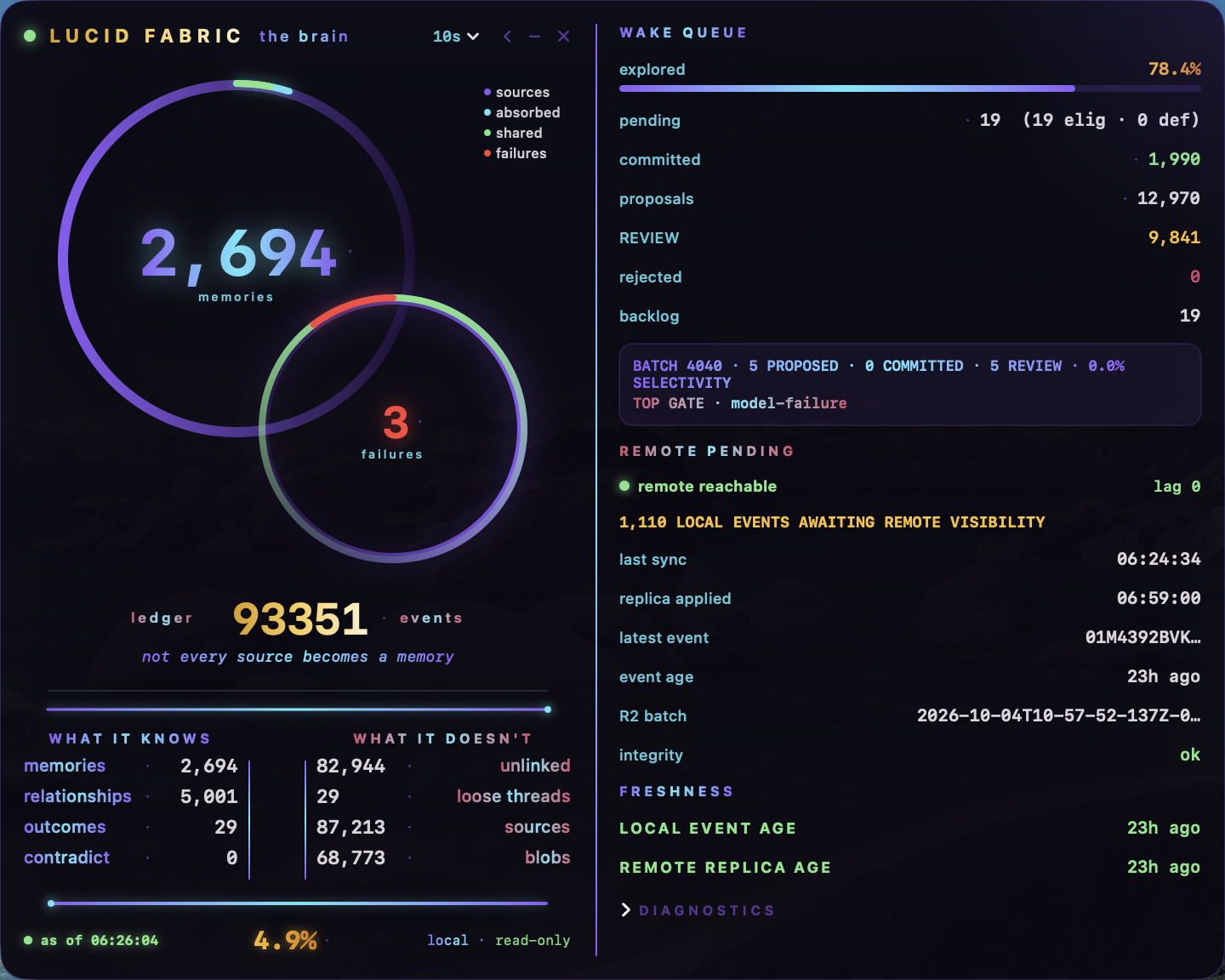
The LF HUD is a native macOS app that monitors the Persistent Persistency brain in real time — canonical integrity, coverage, R2 durability, the read gateway's freshness, and Wake's digestion queue — updating continuously rather than on refresh. It reads the same sanitized projection this site does; it never touches private contents.
Provenance
Know why you believe it.
A useful memory should not merely say what the system believes. It should retain enough lineage to explain why — from what evidence, with what confidence, and under what epistemic status. This is a sanitized, synthetic illustration of that lineage.
Accepted drill report
“R2-only restore produced a byte-identical brain”
Memory: “R2 restore is byte-identical to the canonical brain”
DERIVED_FROM · CORROBORATES
Accepted compare-brains, 2026-09-27
Chief · External Agent Access
Can another AI touch the brain without being allowed to manufacture truth?
AGENT
GATE
READ / WRITE
LEDGER
- An external agent can read bounded context and provenance.
- Authorized contributions can be written as evidence.
- Derived memories created through the Chief interface are constrained to INFERRED / UNVERIFIED.
- Chief can create RELATED_TO links, but cannot arbitrarily manufacture stronger semantic relationships.
- R2 durability ACK is checked rather than assumed.
This is epistemic containment — permissions that protect the difference between fact and inference.
The Proof
WE KILLED THE BRAIN.
Then rebuilt it from the archive.
The first attempt failed by milliseconds.
The strict first run did not pass byte identity. It exposed 0–2 ms timestamp drift on
post-snapshot rows — canonical rows and birth events had been stamped by separate
new Date() calls. The team did not weaken the comparator. The write/replay
architecture was corrected using single-stamp writes, complete birth payloads, replay
consumption, and a regression test. A fresh canonical run was then destroyed and restored
again — producing byte-for-byte identity.
We fixed the architecture instead of lowering the bar — then killed it again.
Accepted drill · 2026-09-27 · the Chief artifact and its derived memory survived with INFERRED/UNVERIFIED status and DERIVED_FROM lineage intact. These counts are the historical drill result — not current brain counts.
What this does not claim
- That retrieval proves learning.
- That persistence makes information true.
- That every stored source should become a memory.
- That inferred memory is equivalent to evidence.
- That Dream output is factual.
- That current coverage is high.
- That a successful durability drill proves every future state is recoverable.
Coverage CURRENT
What does the brain actually know?
Surviving everything is useful — but how much raw experience has become accessible knowledge?
The coverage metric was implemented, measured, and accepted on 2026-09-27 (decision
01M3HNGZ3FBBYZXZRPBM5DMD97, INFERRED/UNVERIFIED). Acceptance is of the metric and its
measurement — not of high coverage. At acceptance, direct derivation measured
2,316 of 87,205 source occurrences (2.66%); in the current snapshot it is
4,092 of 87,213 (4.69%) — rising as Wake's canary absorbs eligible evidence.
43,559 eligible-unabsorbed sources remain; and the lineage check still surfaces 29 dangling
DERIVED_FROM targets
(lineageConsistent=false). Low coverage is reported as low, not hidden.
Death/rebirth answers “Can the brain preserve what it knows?” Coverage asks “How much of what it experienced has become usable knowledge?”
Evolution
How did this become what it is now?
Wake PP CURRENT — SHADOW / CANARY
Continuous digestion of raw history into factual structure
Wake belongs to factual processing — not synthetic imagination. Implemented (Phase 1 shadow projector + Phase 3 semantic proposals) and running under a canary gate on lucid-fabric since 2026-09-29: every derived memory is forced INFERRED/UNVERIFIED, the grounding verifier and information-value gates hold, and no output can silently pollute canonical truth.
Dream PP EXPERIMENTAL DESIGN
What happens after factual continuity works?
Strict PP asks
“What evidence exists?”
Dream PP asks
“What might be possible?”
Experiment asks
“Can we test it?”
Strict PP records the resulting reality.
A reality firewall
- Synthetic content lives in an IMAGINED namespace.
- It remains UNTESTED.
- It carries confidenceAsFact = 0.
- Parent lineage is preserved.
- It never silently contaminates factual canonical truth.
Eight cognitive strains are proposed. They are the same engine under different rules for recombining memory:
- PP-Canonical — the conservative anchor; near-verbatim, evidence-weighted.
- Associative — searches non-obvious relationships across the graph.
- Counterfactual — asks what changes if an assumption is removed.
- Dream — free recombination at the highest novelty pressure.
- Adversarial — attacks candidate conclusions.
- Divergent — generates structurally different possibilities.
- Integrative — combines compatible proposals.
- Mutator — deliberately perturbs candidate structures.
The Fabric
What does all of this look like as a connected system?
A conceptual illustration of the connected system — projects as constellations, evidence nodes, derived memories, relationship paths, provenance trails, and accepted milestones. It is decorative: generated from generic shapes, not aggregated from the private brain. No raw private content is involved.
Journal
Follow the work, not the marketing.
A research lab notebook, not a blog. Entries record the hypothesis, what was attempted,
what failed, what changed, the evidence, and the next question. Entries are rendered from
data/journal.json.
Current State